
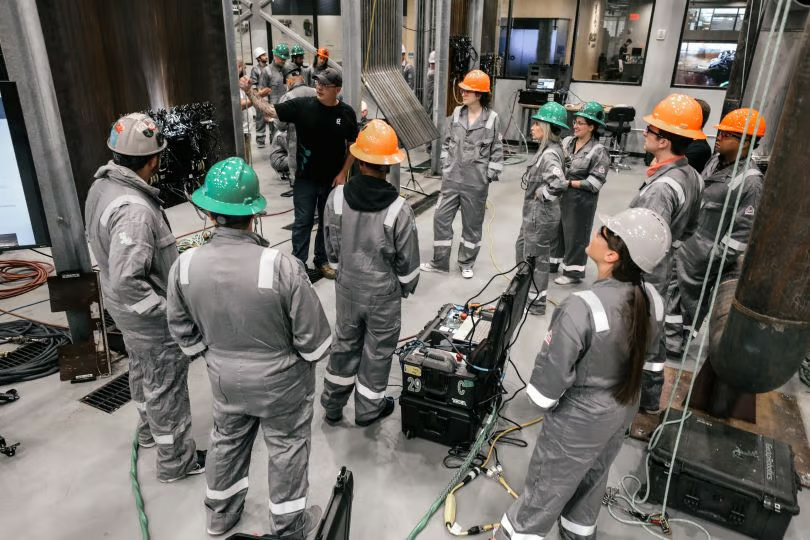
Automation is often discussed purely in terms of efficiency. At Apex, we treat safety as the more important half of that equation, and design automated systems accordingly.
Automating a repetitive drilling task removes a source of manual fatigue and human error, but it also introduces new failure modes that a purely manual process would not have. Our engineering process treats every automation feature as a safety design problem first and an efficiency improvement second.
Keeping Operators in the Loop
We design automation to support operator awareness rather than replace it. Systems are built to make their status and reasoning visible, so that an operator can intervene quickly if conditions change in ways the system was not designed to handle.
This philosophy extends to how we test new automation features. Every system goes through structured evaluation against a wide range of operating conditions, including edge cases that are unlikely but consequential, before it is considered ready to support field operations.
Structured Testing Before Deployment
Before any automation feature reaches a live rig, it goes through staged testing that starts in simulation and only moves to controlled field trials once it has performed reliably against a wide range of scenarios. We deliberately include conditions that are rare but high-consequence, since those are exactly the cases where an untested system is most likely to fail in a way that matters.
Field trials are supervised closely, with clear criteria for what success looks like and clear authority for field engineers to pause a trial if something behaves unexpectedly. We would rather slow down a deployment than let an edge case get discovered for the first time in normal operation.
Learning From Near Misses
We treat near misses, moments where something could have gone wrong but did not, as seriously as actual incidents. Every near miss involving an automated system gets reviewed to understand what the system saw, what it did, and whether an operator had to intervene.
These reviews feed directly back into how we refine existing systems and design new ones. A safety-first culture is not a static set of rules; it depends on continuously learning from the operations already running in the field.
Safety as a Design Constraint
Rather than adding safety measures after a system is built, we treat safety requirements as constraints from the start of the design process. It is a slower way to build automation, but it is the only way we consider acceptable for equipment operating in demanding drilling environments.
Comments (3)
Appreciate that safety is framed as a constraint from the start rather than a checklist at the end.
Keeping operator awareness intact while automating is the hard part. Good to see it called out directly.
Curious what the structured evaluation process looks like in practice, especially for edge cases.
Leave a Comment
Have a project in mind?
Talk to our engineering team about safety-first automation for your operation.
Contact Engineering